lunes, 8 de agosto de 2011


If Maya Deren invented the American avant-garde cinema, Stan Brakhage realized its potential. Unquestionably the most important living avant-garde filmmaker, Brakhage single-handedly transformed the schism separating the avant-garde from classical filmmaking into a chasm. And the ultimate consequences have yet to be resolved; his films appear nearly as radical today as the day he made them.
Brakhage was born in 1933, and made his first film, Interim (1952), at 19. Notably prolific, he has completed several films most years since. To date, his filmography lists over 300 titles, ranging in length from a few seconds to several hours.
Born in Kansas City, Missouri, attended high school in Central City, Colorado. He briefly attended Dartmouth College then left for San Francisco, where he enrolled at the California School of Fine Arts (now the San Francisco Art Institute). He had hoped to study under Sidney Peterson., but unfortunately, Peterson had left the school and the film program was no more, so Brakhage moved on.
Like Deren, Brakhage came to understand film through poetry, and his earliest films do resemble those of Deren and her contemporaries. The early American avant-garde filmmakers tended to borrow liberally from the German Expressionists and Surrealists: mannered acting, symbolism/non sequitur, non-naturalistic lighting and psychosexual themes were common. Still fundamentally story-oriented, these films tend to use a loose, non-linear narrative and dramatic situations to establish metaphorical relationships between images. Deren’s films are closest to those of the Surrealists: though she rejects their often cynical nihilism, her films are steeped in portentous Freudian symbolism.
Brakhage’s early films are more primal. There is no evidence of the Expressionist-inspired preciousness of the pre-WWII American avant-garde filmmakers, and his invocation of Freudian ideas, while omnipresent, is much blunter than Deren’s. For Deren’s cerebral idealism, Brakhage substitutes a rawer, psychologized version of reality. Many of Brakhage’s films from this period are very good, but they are overshadowed today by the films they begat.
While Brakhage’s early films stress psychological themes–the conflict between wish-dream and reality, for example–and retain a strongly dramatic element, they provide frequent glimpses of the formal leap that soon followed.
Despite a rapidly deepening reservoir of ideas, avant-garde film retained a strong connection to the commercial cinema. European avant-garde filmmakers had long made liberal use of photographic effects and trick photography. But nothing they did formally was at all unfamiliar to the commercial cinema, which was quick to pick up on their ideas. But if strange photographic effects are one thing, turning celluloid into a plastic medium was something else altogether.
Brakhage was among the first filmmakers to physically alter the filmstrip itself for metaphorical effect. The most striking example of this technique in his early films occurs in Reflections on Black (1955), which imagines the dream-vision of a blind man as he walks through a city, climbs the stairs of his apartment building and arrives home. Brakhage signals the blindness of his protagonist by physically scratching out his eyes, and splices in bits of film negative to convey the sense of experience the world as a blind man might, not as something seen, but something pictured.
Shortly before making Reflections of Black, Brakhage moved to New York City. That same year, the film critic Parker Tyler introduced Brakhage to Joseph Cornell, who commissioned him to shoot a film of the soon to be dismantled Third Avenue El. Working for the first time without actors or plot, Brakhage began to focus on the expressive qualities of the medium itself. The film which resulted,Wonder Ring (1955), represents Brakhage’s first step toward his radical reconception of the cinema. There is no story, no protagonist, no linear narrative other than the train itself, traveling endlessly along its track. It is a perfect expression of the world defined by the train, and a peculiarly apposite metaphor for the bare logic of narrative itself.
Imagine an eye unruled by man-made laws of perspective, an eye unprejudiced by compositional logic, and eye which does not respond to the name of everything but which must know each object encountered in life through an adventure of perception. How many colors are there in a field of grass to the crawling baby unaware of ‘Green’? How many rainbows can light create for the untutored eye? How aware of variations in heat waves can that eye be? Imagine a world alive with incomprehensible objects and shimmering with an endless variety of movement and innumerable gradations of color. Imagine a world before the ‘beginning was the word.’
With this opening paragraph to his seminal manifesto Metaphors on Vision, Brakhage called into being an entirely new kind of cinema, where none had existed previously. Suddenly, an epistemological question loomed where none had before: What is the nature of the relationship between the moving image and the world, and how might it be represented? Brakhage intended to film not the world itself, but the act of seeing the world. The vast majority of Brakhage’s films are entirely silent. When you watch his films, you are asked to look, and look closely. Where his predecessors used metaphor as a means of relating images to one another, Brakhage’s films were themselves expressions of a single, great metaphor: visual perception.
These questions were by no means unique to Brakhage–they were in fact the catalyst for modern art–but he was the first to realize their implications for the cinema in a body of truly great works of art. InAnticipation of the Night (1958), one sees Brakhage’s first clearly articulated expression of his concept of the vision of the ‘untutored eye.’ While retaining the barest elements of narrative, in this work Brakhage entirely dispenses with the drama, in order to better capture raw experience. The ‘shooting script’ for the 40 minute film consists of a list of 16 concepts, rather than specific shots. Where his earlier films approximated dreams, Anticipation of the Night captures the dreamlike quality of raw experience, the world as it happens and is taken in and understood, willy-nilly.
While making Anticipation of the Night, Brakhage married Jane Collum, who was to become his muse, and the primary subject of his films for many years. Easily the best known of these is Window, Water, Baby, Moving (1959), a document of Jane’s pregnancy and the birth of their first child. Family, and the rituals of family life, became the predominant themes of Brakhage’s films for many years. Birth, sex, and death are the three touchstones of all of his films. In Thigh, Line, Lyre, Triangular (1961), Brakhage again documents the birth of one of his children, and their passage through infancy and childhood is a consistent theme. Several of Brakhage’s films focus on sexual relations, not only between a man and wife, but among friends, and the proto-sexual aspects of childhood. In other films he examines the rituals surrounding death and the body which remains after the being has departed.Sirius Remembered (1959), which documents the gradual dissolution of the corpse of the family dog, and The Dead (1960), made in Père Lachaise cemetery in Paris, prefigure several later films which return to this same theme.
Brakhage’s most ambitious projects of the early ’60s were Dog Star Man(1961-64) and The Art of Vision (1961-64), essentially one film articulated two different ways. Dog Star Man definitively marks the transition from a lyrical style, centered on individual experience, to a more epic style, with a focus on broad metaphysical themes. Roughly speaking, the film expresses a mythic conception of the struggle and fall of Man. Made in four parts, with a prelude, Dog Star Man incorporates many layers of superimposition and a dense, rapid editing pattern. The Art of Visionconsists of exactly the same material as Dog Star Man, but separates the superimposed reels of film in various combinations. As the elements of the film gradually build and cascade into one another, one begins to see the connections between the elements more and more clearly, how and why certain themes are repeated, and the simultaneously epic and analytic quality of the film itself.
Since completing The Art of Vision, Brakhage’s films have become consistently more metaphysical. Even his celebrated Pittsburgh trilogy, completed in 1971, which purported to document three city institutions, at its core deals with metaphysical questions of Being. The three films: Eyes, Deus Ex, andThe Act of Seeing With One’s Own Eyes, document the police, a hospital and a morgue, respectively. All focus on the mechanics of the body: how it is ordered in life, how it is repaired when broken, and what remains when the person who animates it has perished. The key image of The Act of Seeing With One’s Own Eyes is quite likely the bluntest statement on the human condition ever filmed. In the course of an autopsy, the skin around the scalp is slit with a scalpel, and in preparation for exposing and examining the brain, the face of each cadaver is literally peeled off, like a mask, revealing the raw meat beneath. That image, once seen, will never leave you.
The feature-length The Text of Light (1974) consists entirely of abstracted patterns of light photographed through a thick, deep-green ashtray. Anticipating his non-photographic abstract films of the ’80s and ’90s, it reduces photography to its ratio ultima, the influence of light on photographic emulsion.
…in photographing this ashtray for instance, I’m sitting for hours to get 30 seconds of film. I’m sitting watching what’s happening and clicking a frame, and sitting and watching, and further than that, I had shot several hundred feet and they seemed dead. They didn’t reflect at all my excitement and emotion and feeling. They had no anima in them, except for two or three shots where the lens which was on a tripod, pressed against the desk, had jerked. Those were just random, but what gave me the clue. What I began doing was always holding the camera in hand. For hours. Clicking. Waiting. Seeing what the sun did to the scene. As I saw what was happening in the frame to these little particles of light, changing, I would shoot the camera very slightly.
In recent years, Brakhage has focused largely on painting, scratching and drawing directly on the surface of the film strip itself. In eschewing photography altogether he focuses more directly on the bare act of perception. These films recall the paintings of abstract expressionists like Pollock, Klein, Motherwell and Rothko, and pack the same visceral punch. If you’ve ever stood in front of a great Rothko, and felt yourself falling in, the experience of watching the best of Brakhage’s hand-painted films is very similar.
I now no longer photograph, but rather paint upon clear strips of film – essentially freeing myself from the dilemmas of re-presentation. I aspire to a visual music, a ‘music’ for the eyes (as my films are entirely without sound-tracks these days). Just as a composer can be said to work primarily with ‘musical ideas,’ I can be said to work with the ideas intrinsic to film, which is the only medium capable of making paradigmatic ‘closure’ apropos Primal Sight. A composer most usually creates parallels to the surroundings of the inner ear–the primary thoughts of sounds. I, similarly, now work with the electric synapses of thought to achieve overall cathexis paradigms separate from but ‘at one’ with the inner lights, the Light, at source, of being human.
Stan Brakhage died of cancer on March 8, 2003, in Victoria, British Columbia, Canada. The Museum of Modern Art in New York City is in the process of preserving all of his films. His last finished film,Stan’s Window, is a photographed self-portrait. Brakhage left behind the beginning of another film,The Chinese Series, composed of 35mm black leader he had scratched with his fingernails. The film was to end wherever he stopped scratching.

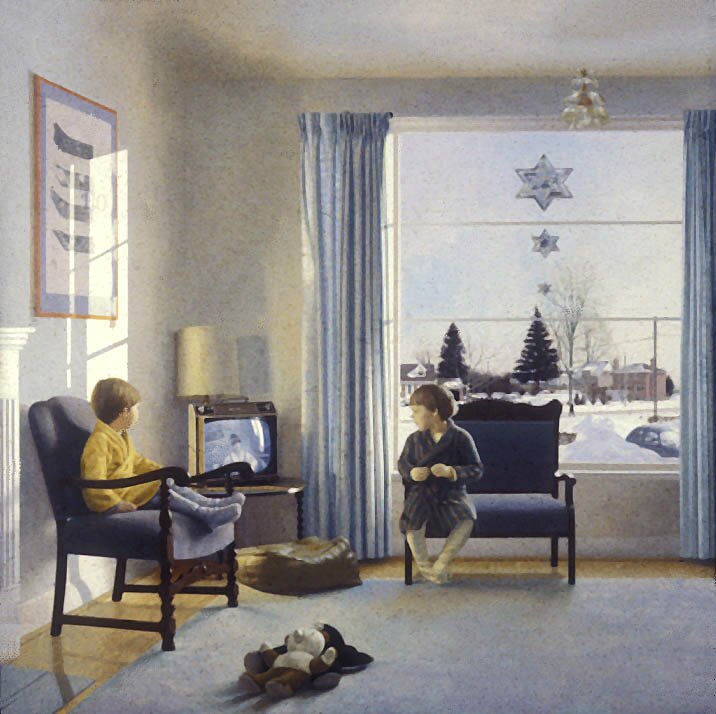
The Films of Jack Chambers


“The fact is that the films of Jack Chambers have changed the whole history of film, despite their neglect, in a way that isn’t even possible within the field of painting. There are no ‘masters’ of Film in any significant sense whatsoever. There are only ‘makers’ in the original, or at least medieval, sense of the word. Jack Chambers is a true ‘maker’ of films. He needs no stance, or standing, for he dances attendance upon the coming-into-being of something recognizably NEW.” -Stan Brakhage 1977

Lure of the Local
“We already know the Mysterious but our minds are not conscious of it. When we open onto the Mysterious we do not do it consciously. But only by doing it do we perceive and only by perceiving can we experience the wonder of familiar appearances.” Jack Chambers 1969
In the late 50s and into the 60s an art community evolved out of London Ontario that was deemed “London Regionalism”. It was composed of a group of artists who acknowledged their home as the centre and subject of creative activity; who acknowledged yet refused to situate themselves in the art world of the metropolitan centre; who refused to participate in ‘movements’. In fact, the term “regionalism” was jokingly adopted by the community in a spirit of defiance after a Toronto critic used it in a derisive way to describe the scene. In reality it was not an “ism” at all but a group of artists who had decided to stay home.

It’s a context I like to emphasize when looking at the films of celebrated London painter Jack Chambers. This was an art community that celebrated the home place --a small conservative insurance town-- in all its manifestations, and autonomously, while completely rejecting its ideals. By the late 60s, this Souwesto town had somehow become the focal point of Canadian art. In Barry Lord’s 1969 article in Art in America “What London, Canada Has That Everywhere Else Needs” he describes London as an art phenomenon: the most important art centre in Canada and a model for artists working elsewhere, the site of “Canada’s first regional liberation front”

Though Chambers was not a self-proclaimed regionalist, he had close ties with the group of artists at work in London through this period. He returned to his hometown after several years of rigorous fine art training in Spain to find an art community that had exploded. His friend and subject of the film R-34, leading figure for the group and a kind of self-appointed spokesperson for regionalism, approaching his own art- making as a free appropriation of meaning within a location, resting on a personal claim over local objects. For Curnoe the only important artwork was myopic, and his immediate surroundings were the only source of interest to his creative process. And although their aesthetic values and fundamental art philosophies differed greatly, they shared this feeling of the importance of the local as the site of inspiration and production.

In Chambers 1969 Artscanada article on his own art philosophy entitled “Perceptual Realism”, he describes a relationship to the reproduction of perceived reality that has no aesthetic; a belief in the possibility of reproducing exactly the perceived external. Only through this transmission of the perceived relationship between the artist and nature, claimed Chambers, could a true spiritual understanding of the energy and life cycle inherent in things be understood.

One problem in Chambers’ writings on philosophy of art and his own work, is that he excludes from his ideas of life, death, and renewal –-that spiritual cycle which he claims as his work’s focus-- elements of terror, anxiety, and an ambivalence. All of which emerge with force in the work itself.

Chambers began filmmaking partly in response to a growing feeling that as his paintings gained more critical acclaim and commercial success, they were beginning to put his audience to sleep. He described the camera as the ultimate device for capturing and displaying that kind of perception that must result in an integrated spiritual connection with place and nature.

But what he deemed the “life-death-life” cycle inherent in all experience, is not always so balanced in these films. Death lingers longer than it might. Present not only in the horrifying images of napalm victims in Hybrid and the slaughter of the lamb in Hart of London, death, confusion, and dread are there in the slowed rites of waiting in a doctor’s office and walking through a park in his first film Mosaic, in the peripheral aspect of human presence in Circle, and even in the consideration of another artist-at-work through repetition in R34.

If a version of London Regionalism can be found in Chambers films it is of a detailed space, not just in the sense of detail which exists as it would in his almost photographic “perceptual realist” paintings, but a detailed way of knowing objects, exploring their connections and attempting to formulate a meaning for their position within a formless chaotic space.

Hart of London
“The houses were unlit and, without their orange banners of human warmth, the street looked abandoned of life. My feet became numb with the cold as the day darkened, and tough little grey flakes began falling from the sky. I looked around to find what it was that had hurt me, and all I saw were the dumb houses, the glitter of steel through a crack in the closing sky, and the hard snow” – Jack Chambers

Recounting one of his earliest recollections of his hometown, as a child walking home from school, Chambers reveals an early impression London that he would carry with him throughout his life. London, or the “truth” of London, became a kind of obsession for him. Close friend and historian Ross Woodman explains that Hart of London represents an “apocalyptic climax [...] in which Chambers finally and fully orchestrates the nightmare vision of his hometown that had haunted and pursued him all his life”

The question of seeing in the perceptualist sense is, for Chambers, the question of finding ways to see, of using art as a practical tool for vision. Hart of London challenges suppositions not only about human behavior but about the very act of seeing. Those elements that can serve to heighten sight and therefore perception are shown to be just as capable of obscuring – primarily through the use of white light. In the film’s first brilliant section, the light of the projector literally absorbs the layers of photographs, flipping a tool of illumination into one of obscurity.
Historically speaking, Hart of London can be understood as microcosmically revisionist --a personal history based in the public using public materials-- that makes no claims of authenticity, but instead claims the right to a creative reworking of its parts. The film is crafted from Chambers own footage of his family, footage taken in an abattoir that he went back to Spain specifically to attain, newsreel footage from London’s CFPL news archives from the 1930s and 1940s, and photographs which he culled from an open call to Londoners in the London Free Press.

It is difficult even for a Londoner to pinpoint where we are geographically at any point in the densely layered first section of the film. Moreover, the many places presented in an instant obscure each other’s precise location. We are lost here in the heart of London, within its architecture constantly appearing and disappearing, and very deliberately made strange.

In the jarring middle section of the Hart of London, a stretch of images of the slaughter of a lamb become the first instance of colour footage in the film, intensifying concentration on the death itself rather than human response to it. It is the literal importation of a visceral and catastrophic event into banal London, giving the city the picture of violence that it needs to grasp its own horror. This is the London that could not understand (that made news out of) the killing of its own hart - -the deer that wandered into the city limits, became confused and trapped and was eventually shot dead by Londoners. The connection between these two and the film’s ecstatic conclusion form a crucial axis. It is a historical reality where Chambers identifies for those who will see it the dreadful human potential to do great harm without realizing it, and the need, as the film begs us, to be “very careful”.

by Irene Bindi
_________________________________
REFERENCES: Chambers, Jack “Perceptual Realism.” Artscanada 136-137 (Oct. 1969): 7-13
Dewdney, Christopher “Oregionalism; Geocentrism and the Notion of Originality”. Provincial Essays 1, no. 1: 3-14. 1987
Lord, Barry. “What London, Ontario Has that Everywhere Else Needs.” Art in America 57, no.5 (Sept.-Oct. 1969): 103-105)
Woodman, Ross. “Jack Chambers as Film-Maker.” Capilano Review. 33 (1984): 47-64

The Hart of London - Jack Chambers


While the link between experimental and horror filmmaking remains largely under-examined, there’s no question that some of the great works of experimental cinema could double as outstanding horror films: Peter Tscherkassky’s Outer Space (which commits unspeakable acts on footage from the 80s horror flick The Entity), numerous titles by Stan Brakhage (i.e. The Art of Vision; The Act of Seeing with One’s Own Eyes), even Michael Snow’s Wavelength exudes an existential nausea in stillness that anticipates Kiyoshi Kurosawa by a few decades. While horror films typically depict violence in cinema, these avant-garde works, especially Jack Chamber’s deeply disturbing 1970 film, commit violence on cinema, doing things to the celluloid medium that can leave both the viewer and the art form traumatically transformed. In The Hart of London, the horror erupts from the clash of human civilization and the great unknown that envelops it: an endless, brutal battle waged on multiple fronts: past vs. present, man vs. animal, wilderness vs. domesticity, surfaces vs. essences.


The film kicks off with a beautiful slow-mo shot of a hart deer leaping out of a forest into the town of London, Ontario, where most of the film’s footage was shot. It’s capture and killing at the hands of the locals sets off a snowstorm of archival photos and film footage, a cinematic blizzard superimposed double exposures, horizontal flips and negative inversions. Chambers’ achievement here is in making the most innocuous footage of small town Canada seem foreign and menacing, a frontier past whose contentious relationship with its environs belie the civic aspirations of its archival imagery. This maelstrom is set to a relentless soundtrack of crashing waves whose initial aural violence gradually settles the viewer into its steady rhythm.

The surf sounds eventually give way to the gentler but no less incessant gurgle of tidepools, introducing the film’s singularly most disturbing passage, where images of  children alternate with footage of sheep being slaughtered, a stunning juxtaposition of humankind’s aspiring mastery over life and death. Chambers orchestrates these dual modes into a flow made possible by the tidepool soundtrack and liquid superimpositions of body parts, vegetation and bodily fluids. A recurring theme of cutting recurs through footage of an infant circumcision, shrubbery being trimmed by giant scissors and a slaughterhouse worker sticking his blade through the necks of sheep, which segues to more brutal, bloody footage of an infant child yanked from a womb. Children frolicking in a too-blue swimming pool interspersed with blood red footage of aborted sheep fetuses (some indiscernible from human counterparts) and a heap of freshly-disemboweled sheep intestines still writhing in digestive activity.

The film’s last movement seems satirically vicious with its leering portrayals of domestic life: Canadians engaged in idiotic lawn games like barrel boxing; posing with their gardens or with a trespassing wolf they’ve killed; pointing at family photos and showing off caged canaries. Despite all the brutality that Chambers has envisioned up to this point, he seems to find these images of safe human home life just as horrifying in their own, somewhat lobotomized way, and in no way reassuring from what lurks beyond their papered walls. The final images of Chambers’ own children approaching wild deer at the edge of a park, as their mother repeatedly hisses “You have to be very careful,” leaves the viewer hanging in a tense, perpetual stalemate between mankind and the world around him.

This rarely screened 1970 film by Jack Chambers is one of the cinema’s strangest masterpieces, mixing poetic and documentary footage to ponder the clash between nature and civilization. With its raw nervous energy, its juxtaposition of color with black and white, and its peculiar array of imagery (the birth of a baby, the slaughter of sheep, the filmmaker mowing his lawn, a field being plowed, dense superimpositions of images that sometimes bleach to near white), The Hart of London recalls an earlier oddball masterpiece, Christopher Maclaine’s The End (1953). Chambers’s film begins with news footage that shows a hart prancing through backyards in London, Ontario, in 1954; its pursuers capture and kill it, and that disturbing scene echoes throughout. In the first half, poetic superimpositions of London create an odd mix of seduction and rebuff, and in the second, Chambers mixes his own footage with news cinematography, suggesting that we’ve reduced both ourselves and nature to images not unlike store-window displays. Chambers, who was diagnosed with leukemia the same year he began the project, once said that the film was about “generation,” and the cycles of life and death are ever present. 
- Fred Camper, The Chicago Reader

The Hart of London combines archival newsreels with original footage while adding an undercurrent of simmering violence to the mix. Superimposing found images of a deer being trapped and killed in downtown London with antiquated images of the city in industrial transition (trolleys and automobiles share the street with horse-drawn carriages), Chambers re-creates an urban history that is original, expansive, and severe. As a parallel to the thematic motif of the persecuted deer, Chambers introduces chilling colour footage of lambs being slaughtered (photographed on a return visit to Spain) at the film’s midway point. Chambers writes, “In the second part of the film [these slaughterhouse] images become symbolic of the pursuit and death of the deer. This theme is repeated again and again in the real images of everyday life.”  These “real images” include several staged, mechanical spectacles (a teenager diving into an icy river, crowds gathering to observe a brush fire), as well as repetitive, banal daily activities (a man trimming his hedges, Chambers cutting his lawn). The consistent tension generated and sustained over the course of its demanding length, without the aid of musical cues or voice-over exposition, demonstrates why The Hart of London is considered Chambers’ greatest cinematic achievement. Fred Camper, for instance, identifies The Hart of London as “one of those rare films that succeeds precisely because of its sprawl.”  Stan Brakhage, meanwhile, has described The Hart of London as one of “the few GREAT films of all cinema – ‘great’ in the meaning of the word which suggests the breadth and depth it contains within the length it supports.”
 - Brett Kashmere, Senses of Cinema Great Directors biography

The Hart of London combines archival newsreels with original footage while adding an undercurrent of simmering violence to the mix. Superimposing found images of a deer being trapped and killed in downtown London with antiquated images of the city in industrial transition (trolleys and automobiles share the street with horse-drawn carriages), Chambers re-creates an urban history that is original, expansive, and severe.
Through the course of the film, man encroaches on nature from every angle. People emerge from underground transport, parachutes fall from the sky and bridges cross water. Even children make sand castles on the beach preparing for the next image of concrete buildings. In the final analysis, nature seems to confront London’s inhabitants as an enigma or threat. At the film’s very end, children (Jack Chamber’s own) approach a hart with food, and their mother whispers warnings; the animal as object, filmed from afar, suffers from a perceptual uncertainty. In the case of a dead wolf, its hunters turn it into their image and have it wave and greet their woman at home, like a man returned from the woods.

While man thrusts himself on the environment, containing it and turning it into his image, Chambers treatment of the filmed image creates a fracture between the filmed and the ‘film’. His jarring superimposition of positive and negative creates particularly interesting deployments of light. In the case of newsreel footage of a horse and cart ploughing the field, he overlays a positive and negative of the same image, and only a small time displacement between the images makes the superimposition readable.Whilst light in cinema creates image and thus life, here Chambers acknowledges this but pushes further asking what it is interpret and recognize, unlike the objective view as propagated by the newsreels he uses and subverts to this end.

Speaking to writer Avis Lang (whose article is reprinted in a 1984 issue of the Capilano Review), Chambers said that The Hart of London is about “generation.” The filmmaker was diagnosed with leukemia in 1969, the year he began work on the film, which might explain its numerous disasters and frequent juxtapositions of life and death. But there are other major threads as well. Like many avant-garde films it explores objective versus subjective perception, and Chambers also suggests that all things are mystically unified by light. His theme that we’re alienated from nature is hardly novel, but it’s intertwined with a brilliant analysis of how news cinematography caters to the viewer’s voyeurism.

Every other major sequence in the film recapitulates the opening’s tension between nature and humanity. About midway through, Chambers juxtaposes two aerial shots: the first shows a few swimmers dispersed across a body of water, the image crisp and high contrast; the second, clearly news footage shot from a passing airplane, records a catastrophic flood, homes surrounded by water in lower-contrast gray. Later in the film, possibly staging a publicity stunt for news cameras, a young man swims across an icy river in winter, until he’s forced out and hustled into a van by police, captured just like the hart. Next Chambers shows victims of some sort of bombing or mine collapse being led from a hole in the ground, the newsman’s lens treating them not as humans but as just another parade for the viewer’s entertainment. In yet another sequence an extremely lush close-up fills the frame with leaves before a focus change reveals a pair of metal clippers trimming the plants; they emerge so gently that one has to wonder if our very conception of nature is shaped by our desire to alter it for display. Near the end of the film Chambers appears trimming his lawn with a power mower, and the rectangular lawns stretching out behind him remind us that we all play a role in carving up nature.

As part of his attempt to deal with the unruly sprawl of life, Chambers embraces contradiction. Perhaps the most dramatic example occurs when he cuts from black-and-white footage of a baby being born to color footage of lambs being slaughtered, the latter shot during a return visit to Spain. The Christian symbolism may seem blatant, yet by juxtaposing color with black and white Chambers startles the viewer, short-circuiting the most obvious interpretation. Writing in Artscanada in October 1969 and December 1972, Chambers described his work as “perceptual realism” and later “perceptualism”; his writings are dense and theoretical, but apparently he wanted to prolong the moment of perception before a person interprets what he sees, placing him in “a state of receptive passivity that somehow releases a higher…sense.” By opening himself up to such “wonder,” a viewer might be able to “perceive the Invisible Body ‘behind’ the world.

An early script for The Hart of London included images of Christ descending from heaven, yet Chambers’s work also seems related to gnosticism, a connection one might infer from his statement that reality is “an invisible pattern of energy which in its attenuated, material form becomes trees, river, people, sky.” The Hart of London seems to set up a similar dialogue between objects and light: dense superimpositions occasionally bleach almost to white, which contrasts image as the container of a recognizable object with image as pure light. Many of the images are of London, including a man with a rifle (echoing the capture of the hart) and an imposing grid of windows from a downtown building. Trees may “attenuate” reality, but human constructions are even more severe.

Chambers aggressively managed his own medical care and lived until 1978, yet The Hart of London reveals a heightened awareness of human vulnerability in the face of nature—the sequence of Chambers cutting his lawn is followed by an aerial shot of stone ruins. And in the film’s penultimate scene, home-movie-style footage that Chambers shot himself, two deer stand by a fence in the London zoo; they aren’t wild, but Chambers’s two young sons approach cautiously while on the sound track their mother repeatedly whispers, “You have to be very careful.” They succeed in feeding the deer, and afterward Chambers pans from a river up to the sky, ending with a view of pure natural light. While Avis Lang takes these last two scenes as optimistic assertions that “the world is a miracle,” the whisper hints that the deer may be dangerous, and more than once the film’s editing has transformed benign activities into disasters. The world may be “full of wonder,” in Chambers’s phrase, but it also has the potential to kill us. 
- Fred Camper, from his feature review for The Chicago Reader.  

“Jack Chambers is one of Canada’s most famous and greatest living painters. Why then have his films been as neglected as they have been? I feel that it is because his films do not arise as an adjunct to his painting (as is true in the case of most other painter film-makers) but that, rather, Jack Chambers has realized the almost opposed aesthetics of paint and film and has created a body of moving pictures so crucially unique as to fright paint buffery: thus his films have inherited a social position kin to that of the films of Joseph Cornell in this country. The fact is that four films of Jack Chambers have changed the whole history of film, despite their neglect, in a way that isn’t possible within the field of painting. There are no ‘masters’ of film in any significant sense whatsoever. There are only ‘makers’ of film in the original, or at least medieval, sense of the word. Jack Chambers is a true ‘maker’ of films. He needs no stance, or standing, for he dances attendance upon the coming-into-being of something recognizably new: (and as all is new, always, one must question the veracity of all works, whatever medium, which beseem everything but that truth).”

Jack Chambers is a renowned realist artist, whose notion of perception as a synthetic experience was formally expressed in a distinctive collage style of filmmaking. Through this style, he influenced the development of the diary and landscape film. In 1969, his aesthetic manifesto, Perceptual Realism, affirmed his belief in art as an intuitive but mediated response to the unity underlying all things. It also confirmed his preference for the photograph as a memory-aid as it preserved the original image without distortion.
Chambers, as a painter, was formally trained in traditional art making. From 1954 to 1959 he attended Madrid’s Escuela Central de Bellas Artes de San Fernando where he excelled as a student, winning the state prize for painting and the Paular Scholarship for landscape painting. He chose to study in Europe because he felt constrained by London’s conservative environment and the inadequacies of his local technical school, H.B. Beal. In his 1978 autobiography, he wrote, “I could only go so far with what I was doing… coming to the same deadend again and again.”

Spanish culture exerted a major influence on Chambers, and many aspects of his work reflect this influence: the preoccupation with death and recollection, the surrealist challenge to the normality of surface reality, an appreciation for light’s revelatory power and references to Catholic iconography. Other influences include mysticism, especially the writings of Saint Teresa of Avila; the occult and parapsychology, where notions of an underlying life force or energy binds all things together. All of these ideas contributed to Chambers’ belief in the visionary nature of the artistic experience. For him, the moment of individual self-awareness when “our souls and the souls of things become present to one another” encompassed myriad associations, past and present, which took the form of temporal and spatial disruptions in his artwork.

Chambers might have settled permanently in Spain, but he returned home in 1961 because of a family illness. His encounter with the landscapes of his youth and the memories it engendered had a powerful effect on him: “The memory of such places multiplied the longer I remained so near them, and the images wedded to their presence surfaced in me like the faces of long lost friends.” He realized his representations of Spanish culture would never possess the same resonance, and so he returned to London.

Collage artist Greg Curnoe, Chambers’ closest friend, recalled that Chambers started using a 16mm camera in 1964 to explore the London landscape. In an interview with arts reporter Lenore Crawford in 1969, Chambers remarked on how film was a liberating influence: “After I shot hundreds of feet of film and then edited it to eliminate the non-essentials, I realized what I needed and what I could leave out of a painting…. A painting doesn’t need to tell a story of any kind. It can be appreciated for what’s in it. There doesn’t even have to be relation of objects.” This statement describes his films equally well.
Chambers’ reputation as a film artist is based on the five works he completed between 1966 and 1970: Mosaic (1964–1966), Hybrid (1967), R34 (1967), Circle (1968–1969) and The Hart of London (1968–1970). A mixture of newsreel footage, home movies and photographs, these films reject the notion of linear time, characteristic of popular cinema, because Chambers thought the narrative illusions that resulted misrepresented the true character of human perception.

Using various montage strategies — semantic and formal — his films invest the viewing experience with a sense of “presentness,” so that individuals undergo the same process of self-awareness as Chambers (confrontation of the fragility of domestic happiness, the brutality of human nature, the challenges of artistic ambition, the inevitability of death).
- Kathryn Elder, The Film Reference Library
Elder is the author of The Films of Jack Chambers. Published by Indiana University Press, 2003

The paltry critical recognition afforded Jack Chambers’ films in the ’60s and ’70s by Canada’s film intelligentsia is typical of the avant-garde’s marginalised status during its formative period. It should not be surprising, therefore, that most of the criticism of Chambers’ film work of that time was published in visual art periodicals such as Canadian Art, artscanada and Artmagazine, and usually integrated with commentary on painting. Barry Lord, writing in artscanada, suggests that Chambers’ films have “begun to recapitulate the development of his paintings.” Gene Youngblood, also in artscanada, states that “Chambers, in my estimation one of the most important painters at work today, manages to invest his films with that special quality of ‘cosmic fantasy’ that characterizes his paintings.” Mario Amaya, in a review of Chambers’ paintings published in Art in America, observes that Circle “approximates the analysis of changing light on a particular subject that so obsessed Monet.” ) The expansion of Chambers’ formal and thematic concerns from painting into filmmaking is also the theoretical underpinning of Bruce Elder’s detailed analysis of Circle. His essay “From Painting into Cinema” is the most thorough and convincing example of this approach so far. By expounding on Chambers’s period of silver paintings (1966/67) as a key transitional passage in the development of his cinematic interests, Elder cogently traces the artist’s preoccupation with light and time as manifested in Circle, and investigates the Romantic character of Chambers’ ideas about art, nature and perception, as set out in his artistic manifesto “Perceptual Realism,” showing how these ideas, too, find a precise articulation in Circle.

Jack Chambers’ position in the Canadian avant-garde cinema of the 1960s can be assessed by reference to the changing contours of Canadian cultural policy around the time of Expo 67 (held in Montreal). Other factors, such as the Canada Council’s financial commitment to experimental film beginning in 1967, the emergence of the campus underground as a viable alternative exhibition network, the establishment of Canadian Artists’ Representation (CAR), also in 1967, and the development of independent film distribution cooperatives in Toronto, London, Montreal and Vancouver late in the ’60s, all helped to determine the practical conditions necessary for a sustainable Canadian avant-garde cinema.

Since the avant-garde cinema was proposing a new kind of film, a new kind of viewing environment was also necessary. The 16mm projection equipment that had been integrated into schools and universities during the 1950s helped to provide an exhibition and distribution network for the Canadian avant-garde in the 1960s: college campuses essentially began to function as a ready-made parallel theatre chain. Chambers’ primary motivation for forming the London Film Co-op in 1968 was to get his films distributed. In the 1960s, thanks in part to the New American Cinema’s breakthrough success (not to mention Andy Warhol’s international celebrity), screenings of avant-garde films on Canadian university campuses became quite common. Through these screenings, Canadian film experimentalists such as Chambers had an opportunity to network with and gain knowledge from their American opposite numbers. Chambers was especially influenced by Stan Brakhage’s work; Brakhage’s Window Water Baby Moving (1959) has been cited as a primary inspiration for Chambers’ first film, Mosaic. Brakhage was also instrumental in getting Chambers’ films some distribution in the United States, initiating Chambers’ first American screening, held on November 15, 1977 at Pacific Film Archive. However, because Chambers was unable to travel due to his deteriorating health and myriad artistic commitments, his films were, even then, seldom noticed beyond the occasional passing references in film festival or visual art overviews. The contrast between Brakhage’s ubiquitous presence and Chambers’ near absence (except close to home) on the late ’60s university circuit helps explain why Chambers’ films were not more widely seen and, therefore, written about.
The emergence of the campus underground, coupled with the establishment of film co-operatives like Canadian Filmmakers Distribution Centre, London Film Co-op, the Intermedia Film Co-op (Vancouver), and the Independent Film Makers Co-op (Montreal), allowed an effective system of distribution to develop; this network of parallel co-ops also helped to establish lines of communication between filmmakers in different parts of the country who would otherwise not have had means of contact. Jack Chambers’ pioneering involvement with CAR, a national arts service organisation founded on Chambers belief in “fair exchange: payment for services,” assured that filmmakers would eventually be compensated for the exhibition and reproduction of their work. It was within this cultural-historical milieu that Chambers worked to unite the various aspects of what remains Canada’s experimental film apparatus.

His most decisive contribution to the development of a sustained, alternative Canadian cinema, however, was in the films he made, expanding on his own artistic strategies and concerns. As an early predecessor of subjective autobiography, Chambers’ work anticipates the first-person, diary strain that surfaced in Canadian avant-garde film during the 1960s and ’70s, emerging simultaneously in films such as Chambers’ Mosaic and Circle, Watersark (Joyce Wieland, 1965), and personal documentaries made by the NFB experimentalist Derek May. (21) The traces of this impressionistic diary mode can be located in a wide range of later films including House Movie (Rick Hancox, 1972), The Art of Worldly Wisdom (Bruce Elder, 1979), The Road Ended at the Beach (Phillip Hoffman, 1983), Was (Mike Hoolboom, 1989), and You Take Care Now (Ann Marie Fleming, 1989). And the integration of quotidian subject matter and amateur tactics into film texts and formal repertoire, by, respectively, Chambers and Wieland, effaced the boundary between avant-garde film and “home movie.” Films such as Nursing History (Marian McMahon, 1989), Girl from Mouch (Gariné Torossian, 1993), Zyklon Portrait (Elida Schogt, 1999), and What these ashes wanted (Phillip Hoffman, 2001) testify to the enduring influence of Chambers and Wieland on the fusion of art and life in Canadian first-person cinema.
- Brett Kashmere, Senses of Cinema Great Directors biography

Jack Chambers Paintings

miércoles, 22 de junio de 2011

Gregory Markopoulos Seconds in Eternity


Gregory Markopoulos
Seconds in Eternity
Cinema's long-lost "supreme erotic poet" has come back to the fold — briefly
Gregory Markopoulos
How does it happen that a filmmaker once lauded as "the Americanavant-garde cinema's supreme erotic poet" vanishes entirely from the cultural landscape? Gregory Markopoulos was complicit in his own disappearance from the histories of modern art and cinema, where by any reasonable standard he belongs in the very forefront.
In 1967, after nearly two decades of brilliant, innovative filmmaking, Markopoulos and his lover, Robert Beavers, abandoned the U.S. for Greece. They not only left physically; they also prohibited the distribution of the films in America, refused interviews, and demanded the excision of a chapter on the director in P. Adams Sitney's seminal Visionary Film: The American Avant-Garde from later editions. It was only after his death (from lymphoma in 1992), and in fact only in the last year or so that Beavers, a vigilant guardian of Markopoulos's work, has allowed it to be shown in the U.S.
Seeing these films after 30 years of unavailability gives us a welcome chance to reevaluate this uniquely gifted artist. Born in 1928 in Toledo, Ohio, Markopoulos starting making movies at age 12. His subjects were classical and romantic: novels by Dickens, Bronte, and Hemingway. By the age of 18 he was well versed in cinema aesthetics and those whose work made the greatest case for cinema as art: Josef von Sternberg, Jean Cocteau, Buñuel. If we say he was influenced by these auteurs, it isn't to imply that he was derivative. His 1947-1948 trilogy Du sang, de la volupte, et la mort (Of Blood, of Pleasure, and of Death) already shows formal innovations that set his work apart and would continue to do so — specifically, the flash-cut, where the screen goes dark briefly between shots, creating a kind of trance state in the viewer. Later, he would expand this device to stunning effect with in-camera superimpositions, double-exposures, and the breathtaking "strobe-edit" where images flash on and off sometimes apart from, sometimes within other images. These strategies are part of Markopoulos's elliptical, imagistic approach to the narrative, where the viewer is seduced into participating in what's occurring onscreen in a way that's impossible in linear narrative.
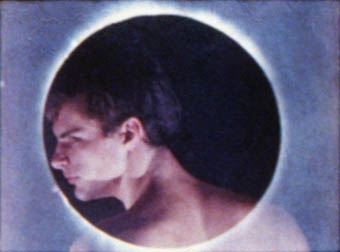
Homosexual and lesbian themes appear in Du sang and other early films. Swain (1950), inspired by Nathaniel Hawthorne's Fanshawe, features a dreamlike narrative of a young man's ritualized rejection of heterosexuality, as a mysterious woman in white gossamer pursues him through a ruined landscape. The handsome Markopoulos appears in several of his own films, and stars in this one. By the early '60s, with works like Twice a Man (1963) and later, The Illiac Passion (1967), his celebration of the male body and an incorporation of homosexual imagery into a wider aesthetic fabric reaches its peak. Both films draw again on classical sources — the former the myth of Hippolytus and Phaedra, the latter Aeschylus's Prometheus Bound. The imagery inThe Illiac Passion is striking in its hypnotic repetitions, particularly in a sequence where a man repeatedly attempts to walk, but finds himself unable to move, perhaps trapped in the director's powerful mise-en-scene. The filmmaker isolates portions of the nude male body to fragment the viewer's perception, then flashes images of the whole man in naked splendor. Warhol regular Taylor Mead adds some amusing moments as a kind of demented bird-figure in a pink tattered dress, but most mesmerizing is the recurring motif of the romanticized male in a posture of longing. In one highly charged sequence, a beautiful man lies in a bathtub holding a scarab, which he slowly kisses.
Gregory Markopoulos
Markopoulos's power as cinematic inventor extends to his soundtracks. In The Illiac Passion, he reads from Thoreau's translation of Prometheus Bound but he "edits" the words just as he does the images, repeating phrases as if they were chants, with the repetitions alternating with silences.
By the time of the short Ming Green (1966), Markopoulos had brought his formal innovations to an extraordinary level of clarity and simplicity. This brief film, a paean by the filmmaker to his New York apartment (the title refers to the color of the walls), dazzles the viewer with its use of the strobe-edit and the superimposition, bringing an empty, quiet space to gorgeous, glittering life.
A year after Ming Green, Markopoulos moved to Europe, where he continued to make films, some of which have yet to be developed. Like the classical sources that inspired his work, Greece held the promise of something he couldn't find in America, a kind of artistic purity without the demands of commerce or the more subtle pressures from a fickle avant-garde. He and Robert Beavers developed the idea of a pure exhibition space — an open-air field in the Greek countryside — in which to show his films. This concept, despite its practical difficulty, is in keeping with the poignant perfection of Markopoulos's artistry, and represents the same uncompromising ideal that drove his work.
November 1997  
Gary Morris

Gregory J. Markopoulos


For those familiar with the peculiar history of Gregory Markopoulos' cinema, to view one of his shimmering, complex films, with their elusive themes of memory, desire, and creativity, is to grapple with the knowledge that the work itself may be on the verge of slipping from their grasp. Rarely seen and nearly forgotten, Markopoulos' films were once compared to the works of Joyce, Proust, and Eisenstein. In certain circles they have assumed the weight of legend: Stan Brakhage, in a lecture held in conjunction with the Whitney's recent retrospective, spoke for many in the audience when he remarked that "the fall of the Berlin Wall was no more surprising" than finding out that he would be able to see some of these films again.
Markopoulos himself is responsible for much of his critical obscurity: in 1967, he left the United States for Europe with his companion, the filmmaker Robert Beavers, and shortly thereafter withdrew his films from distribution. The reasons for his departure were said to include his distress over what he saw as a growing commercialism in the independent-film community, as well as a horror of the Vietnam War. He later tried to prevent his then-much-discussed work from being written about, most notoriously insisting that much of the commentary on his films be struck from the second edition of P. Adams Sitney's definitive 1974 text on the American avant-garde, Visionary Film. Unfortunately, such actions effectively obliterated Markopoulos' work from the history of a movement for which it had monumental importance. At the same time, his resistance to most critical analysis was a reminder of the extent to which his work - which shatters and reconfigures language as much as it does conventional cinematics - eludes description.
Markopoulos' vision of narrative - which he called a "landscape of emotion" - was remarkably clear, as were his ideas about the relationship between sound and image. In Twice a Man, 1963 (a film inspired by the myth of Hippolytus and Phaedra), a staggeringly complex "musical-mathematical" structure, prefaced by two minutes of black leader and the sound of falling rain, is formed from frames and clusters of frames that not only introduce and establish characters, but also signal subtle shifts in weight between past, present, and future. Markopoulos later chose to shatter the film's dialogue - which is spoken only by Phaedra and is juxtaposed with music, other sounds, and silence - into rhythmic syllabic fragments. Suggesting many layers of consciousness, Twice a Man reinvents cinematic and literary paradigms. When the protagonist, Paul, enters his mother's house, blue-green and glittering with windows, he resembles one of Cocteau's poets passing through a mirror to encounter a symbolic death - an image often reflected in what Sitney, expanding on the writings of Parker Tyler, labeled the American "trance film" tradition. Paul is also crossing into the deepest recesses of his memory - into labyrinthine spaces that echo with color and shards of language. Twice a Man's indelible imagery includes Phaedra's lips, a flickering red gash stretched across the frame, and Paul's face at the film's close, blurring into a rain-drenched window, then falling from the frame in pieces as the glass shatters to the sound of cracking ice.
The Illiac Passion, 1967, which features chiaroscuro passages reminiscent of Anger's Inauguration of the Pleasure Dome of 1954, and incorporates 25 characters, is loosely based on Aeschylus' Prometheus Bound. For a viewer seeing this extravagant ode to creation some thirty years after its making, the film's most plangent moments involve Markopoulos' affectionate casting of friends as mythical figures - Andy Warhol's Poseidon pumping on an Exercycle above a sea of plastic, Taylor Mead's Demon leaping, grimacing, and streaming vermilion fringes, and Smith's bohemian Orpheus, spending a quiet afternoon at home with Eurydice.
Though Tyler sometimes championed Markopoulos' films, he was rather myopic about the filmmaker's most innovative work, complaining, for example, that Himself as Herself, 1967, comprised "an aesthetic variety of drag, numerous decorative posturings [and] the relentless presentation of a young man fixated on his own image." Inspired by Balzac's Seraphita, a novel about a hermaphrodite who metamorphoses into an angel, the film - which opens with an electron microscope and closes with an ascension set in Boston's Trinity Church - transforms narrative into an "emotional landscape" to a nearly vertiginous extent. There is little plot to speak of, only evocative gestures and hauntingly strange, indefinitely signifying images suggestive of a fluctuation in gender. So intricately interwoven that they appear to shimmer, these images include a gilded foot, ornate fans fluttering to the sound of birds chirping, a piece of fur, a wedding dress in a glass-faced cabinet, and the film's sole actor, alternately clothed in a tuxedo and a sari.
The Mysteries, 1968, is a mournful work in which, as in many of the earlier films, the rhythmic repetition of imagery evokes poetic speech, and changes in costume emphasize shifts in time, space, and emotion. Here, a young man's struggles with memories of love and intimations of death are set alternately to deafening silence and the music of Wagner. For him, as for the other beautiful protagonists in Markopoulos' work, love involves as much anguish as pleasure, inducing a fracturing of identity signaled by flashes of imagery that seem to transport the character to other places and times. Significantly, Josef von Sternberg, with whom Markopoulos studied, was among the few Hollywood filmmakers who he felt matched his filmic ideal, and in his work there are echoes of Sternberg's depiction of erotic passion as at once excruciatingly painful and yet the only persistent truth. In Markopoulos' singularly pure vision, desire and art are inseparable - the filmmaker, he wrote, should "ravish the screen with his own vision."
Markopolous died in 1992, and Beavers, his survivor, in allowing his long-inaccessible work to be shown in selected programs, hopes to gain support for the completion of the Temenos, an archive, library, and theater in Lyssaraia, Greece, dedicated to the preservation and presentation of his and Markopoulos' work. Most of Markopoulos' films from the '70s on - including Eniaios (Unity, 1948-ca. 1990), over one-hundred works reedited to form a unit in 22 cycles - have never been printed due to lack of funds. The most urgent need to which Beavers directs his energies, then, is preservation. Film being the fragile medium that it is, if internegatives are not made, these works could vanish unseen.
Markopoulos yearned for his work to be viewed in an ideal context, by an ideal spectator. In the remote and idyllic spot that Beavers describes as the Temenos site, Markopoulos' work may or may not have a more powerful effect than it does when one has wandered in off a chaotic urban street, but it is perhaps appropriate that it should find its haven there. In the end, Markopoulos ensured his work's obscurity not so much through his attempts to control the way it was received, as through his fierce resistance to the perils of commercialism in the arts. At a time when the films of his peers are also neglected, however, the Temenos may be a haven from a different set of problems facing avant-garde cinema. One hopes that it will at least preserve these complex and exquisite films that they may receive the recognition they deserve.